Creating Data Sets in openLCA - Data Aggregation
Background
One of the main challenges in the creation of LCI datasets and databases is balancing transparency and the protection of suppliers’ intellectual property.
For suppliers, there is very little incentive to share process or product data at the level of granularity required to make a high-quality, transparent LCI dataset. As a result, several strategies for preserving supplier IP in the creation of LCI datasets have been developed, all centred around the concept of aggregation.
The goal of these aggregation strategies is to ensure that datasets are representative of reality without exposing the process data of any one supplier. This anonymisation is a critical step in creating high-quality, FAIR, open-access datasets. openLCA supports you with this in several ways.
Vertical Aggregation vs Horizontal Averaging
In vertical aggregation, multiple unit process inventories (UPIs) are combined to create a single dataset representing the entire production chain. A fully vertically aggregated dataset is known as a system process (effectively a life cycle result saved as a process, see process chapter, with only elementary flows). Datasets can also be partially vertically aggregated (also known as partially terminated datasets). More details on fully vs partially terminated datasets are provided below.
Vertical aggregation provides the datasets with the most realistic representation of production chains while still maintaining supplier confidentiality [1].
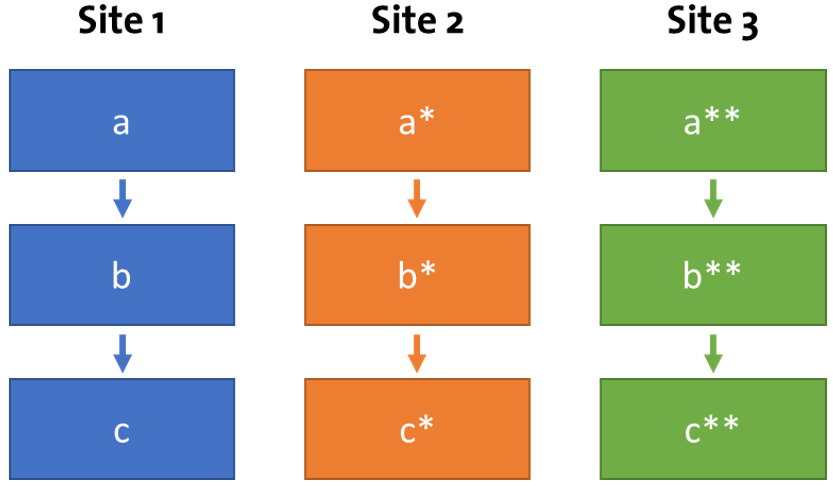
Three production chains comprised of three individual UPIs
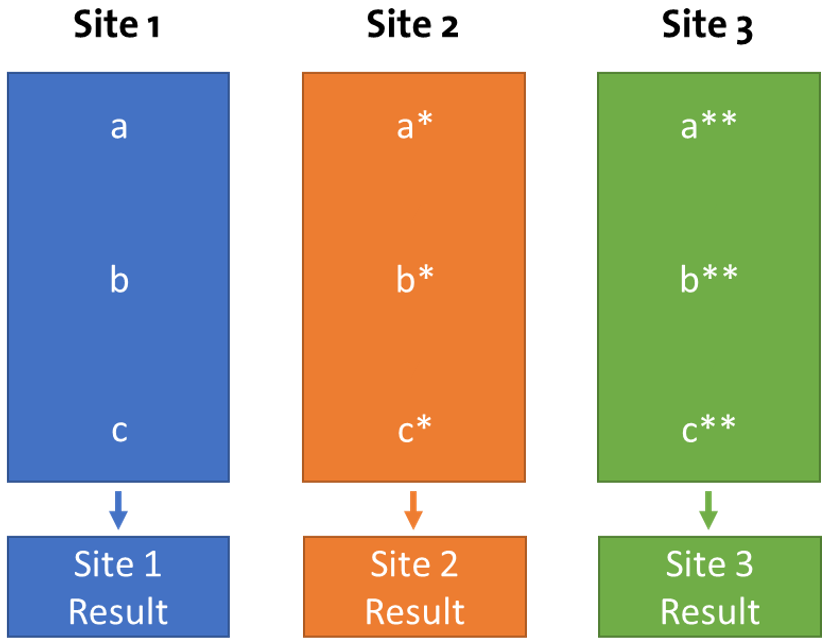
Vertical aggregation across three production sites
The latter approach has been conducted in our research project PRIMUS to generate EcoProfiles of plastic recyclates. Have a look at the respective methodology (download directly).
To create a horizontally averaged dataset, multiple UPIs or aggregated processes from different production chains that supply the same reference flows are combined. For unit processes, all exchanges are averaged. For system processes, the inventory results of each process are averaged to create a new dataset. Horizontal averaging allows data representing a broader range of production sites/types to used, but is methodologically less robust than vertical averaging due to potential differences in the averaged operations [1].
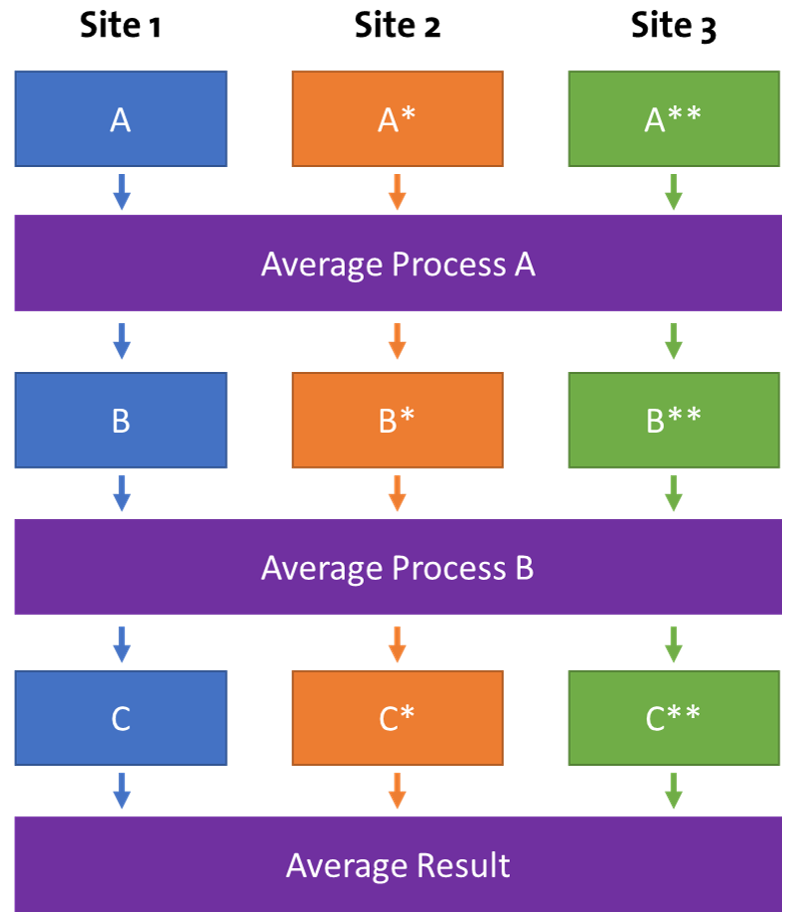
Horizontal averaging across three production sites
Both types of aggregation can be either company-specific or an average of different suppliers within an industry [2]. A hybrid of vertical and horizontal averaging approaches is often used in the creation of datasets.
Fully vs Partially Terminated Datasets
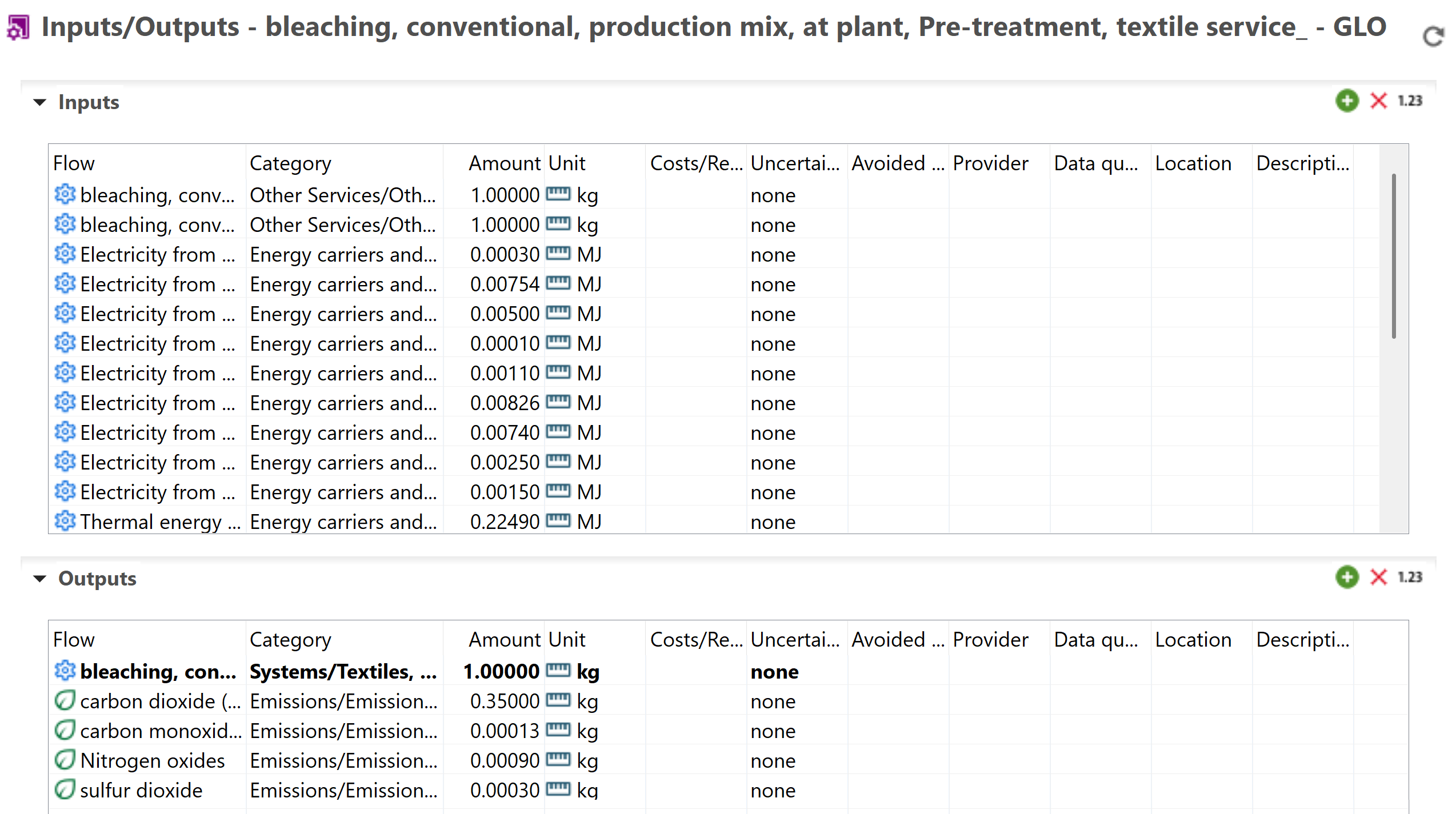
A fully terminated dataset (also known as a system process) is a dataset that contains the entire product system within its boundaries. Since all intermediate exchanges are generated and consumed within the system boundaries, the inputs/outputs appear as a list of only elementary flows [3]. By removing any intermediate exchanges from the dataset, fully terminated processes protect confidential IP while still allowing LCA practitioners to calculate life cycle impacts [2]. However, the lack of transparency provided by fully terminated processes means that users lose oversight over the background system and are unable to adapt processes, limiting the flexibility of the model. Furthermore, comparability between fully terminated process datasets can be limited due to differing assumptions made regarding allocation, cut-off etc. Historically, fully terminated processes have had the added benefit of requiring less computational power in LCA calculations. However, recent technological developments, such as precalculated database libraries developed by GreenDelta mean that there is often no longer a meaningful difference in calculation speed between unit and system process datasets.
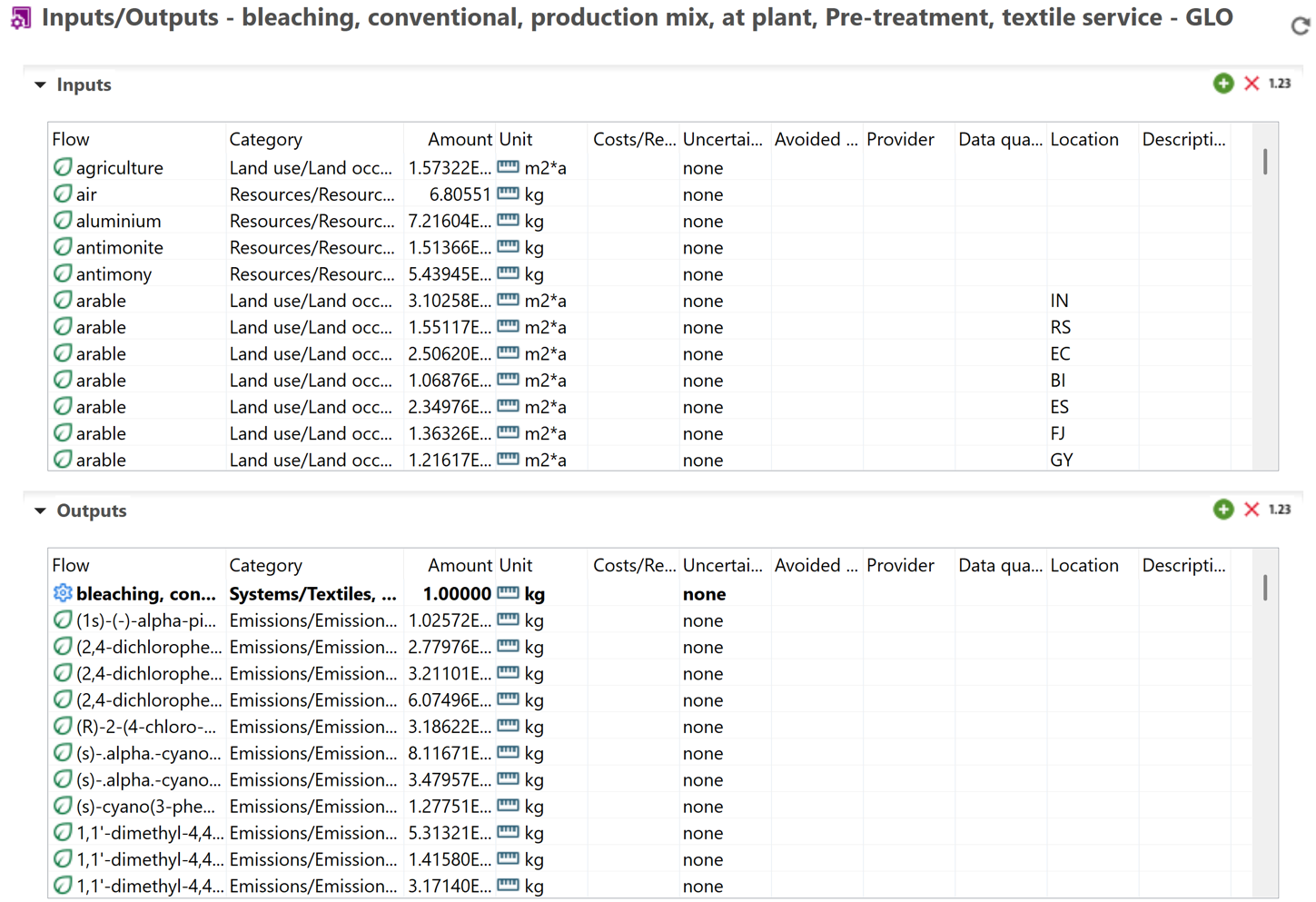 Screenshot from openLCA showing fully terminated process (system process)
In addition to fully disaggregated and fully terminated processes, datasets can be created in a “partially terminated” format. Partially terminated datasets consist of an almost completely aggregated dataset except one or more intermediate exchanges listed that the user can connect to background datasets [4]. This allows to still protect details of activities without neglecting transparency or updatablity.
Screenshot from openLCA showing partially terminated process
In all cases, GreenDelta is happy to provide support for extracting and sharing LCA data using openLCA.
Data Aggregation in openLCA
There are several ways to perform data aggregation in openLCA. The fastest is to calculate the results of your product system and save them as a novel system process by clicking the "Save results as..." button in the "General information" tab of the results window see process chapter:
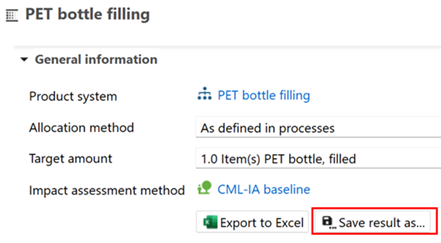
Save as result:
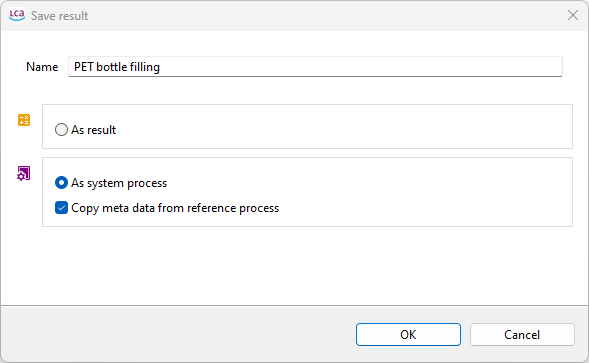
You can then generate a system process, which can be further exported as an ILCD or JSON file and shared with other practitioners.
If you want to produce a partially terminated process from your results, you need to hold intermediary flows in your calculated flow (the supply chain should not be fully resolved):
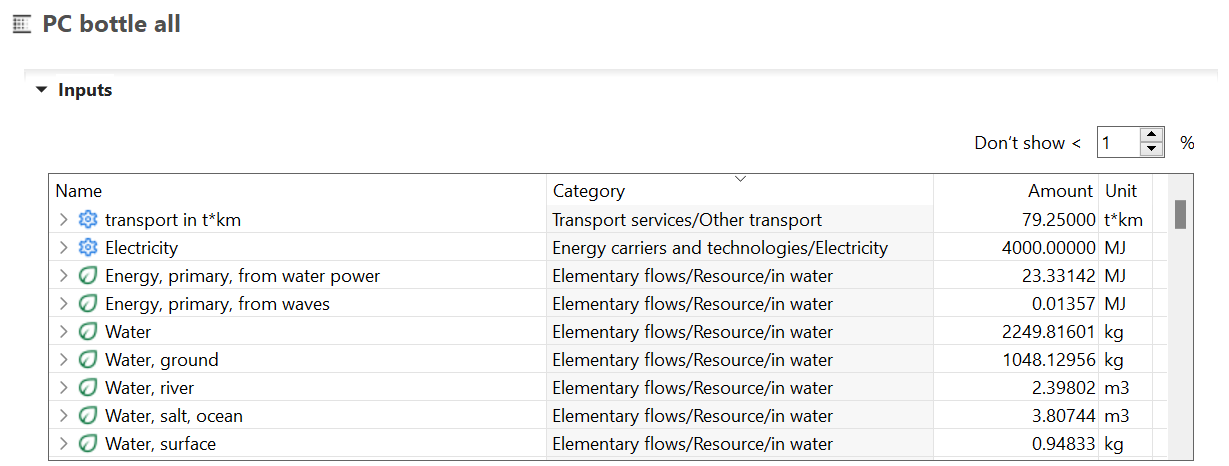
You can follow the logic presented in the Validation Chapter by disconnecting respective product flows from your reference process in the model graph or by not setting the provider on process level prior to the product system creation and removing the tick from 'auto-link processes. This will give you an inventory solely consisting of intermediary flows and direct emissions from this process you can export again as described above.
This can also be done using various scripts; feel free to reach out to us for consultancy on this matter.
Relevant sources:
[1] PlasticsEurope, ‘Eco-profiles program and methodology’. Accessed: Oct. 07, 2025. [Online]. Available: https://plasticseurope.org/wp-content/uploads/2024/03/PlasticsEurope-Ecoprofiles-program-and-methodology_V3.1.pdf
[2] United Nations Environment Programme and SETAC, Global Guidance Principles for Life Cycle Assessment Databases. 2011. Accessed: Dec. 11, 2025. [Online]. Available: https://www.lifecycleinitiative.org/wp-content/uploads/2012/12/2011%20-%20Global%20Guidance%20Principles.pdf
[3] ‘Life Cycle Terminology 2 - Life Cycle Initiative’. Accessed: Jan. 16, 2026. [Online]. Available: https://www.lifecycleinitiative.org/activities/life-cycle-terminology-2/
[4] European Commission. Joint Research Centre., Guide for EF compliant data sets. LU: Publications Office, 2020. Accessed: Sep. 25, 2025. [Online]. Available: https://data.europa.eu/doi/10.2760/537292