Product system
Product systems are life cycle models and are used to calculate inventory results and impact assessment.
A "product system" is described by ISO 14040 as a "collection of unit processes with elementary and product flows, performing one or more defined functions, and which models the life cycle of a product." In openLCA a product system is a set of processes connected by flows, performing one or more defined functions and modelling the life cycle of a product. A product system has a reference process with a defined amount of the product (referred to the functional unit), which serves as basis for calculating impacts for all connected processes within the system.
Source: openLCA 2 manual — Product Systems
- Create from a process
- Get from the database
- Update with more info
- Add a parameter redefinition set
- Move to a category
- Delete a product system
Types of product systems
A process describes a single activity through its inputs and outputs around a quantitative reference. A product system goes one step further: it links many processes through their flows, starting from a reference process, so results can be calculated across the whole supply chain.
Product systems differ mainly in how they are built:
- Linked to unit or system processes — where no provider is set, the supply chain connects either to unit processes or to system processes (fully detailed steps versus an aggregated result saved as a process).
- Nested — a product system can itself serve as the provider for another, giving a "nested" product system whose sub-results show up in the overall analysis.
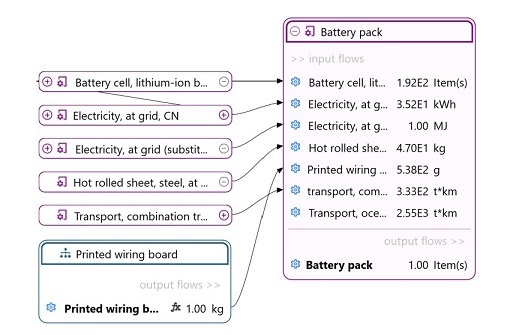
Example of a nested product system: the "Printed wiring board" product system feeds the "Battery pack" as a provider.
These are advanced topics; for the details see the openLCA 2 manual's advanced product systems features.